I have a title for this photo: One Mastepiece by Owen Finn. I could write a novel about such scenes, really.
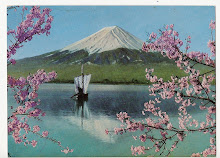
YOKOHAMA PICTURE SHOW

Shot with my Petri in Yokohama 1962
RICE FIELD IN JAPAN 1962
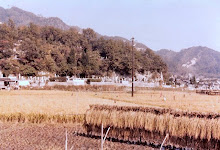
I took this with my PETRI in Kanagawa Prefecture
Sunday, August 14, 2011

Best Place to Write Novels

Yes. Once I get back to Japan, I hope to find a room like this to write the novel that lives in both my heart and mind.
Thanks to Yoshihiko Inui for a photographic masterpiece.
maiko od genka

...she sent me a photograph of herself in a kimono like this one and I was sorry that we had said "sayonara." That was in 1964.
THE BEACH VENDOR -- A Happy Snack of Japanese "Oden"

THE BEACH VENDOR -- A Happy Snack of Japanese "Oden"
Ca.1898 photograph by T. ENAMI of Yokohama. ODEN....Yummy ! What you are looking at here is the Japanese equivalent of a Hot Dog Stand along the boardwalk of Atlantic City or Coney Island. If native Japanese looked at this picture while hungry, they would probably start to drool. www.t-enami.org/
MOTOMACHI STREET SCENE 1962, By Robert L.Huffstutter

HISTORY OF MOTOMACHI, WIKIPEDIA REFEERNCES.......
Motomachi was originally a quiet farming and fishing village until 1859, when the Port of Yokohama was opened. Since then, the close-by Kannai district became the foreigners' business district, and the adjacent Yamate and Yamashitacho districts became the foreigners' residential districts. Situated in-between, with Yamate to the east, and Kannai and Yamashitacho to the west, Motomachi became frequented by many foreigners. Shops and businesses were opened, catering to the needs of foreigners.
Soon after the start of the Meiji era, the number of foreign residents increased. And western influence became more evident in Motomachi, with the opening of many cafés, bakeries, and boutiques. Such shops were uncommon in Japan at the time, and Motomachi helped introduce Western culture into Japan, as part of what is called bunmei kaika (文明開化?). This was the beginning of the Motomachi Shopping Street as it is known as of 2008.
In the 1970s, the "Motomachi Shopping Street" produced a new style of fashion called the hama tora (ハマトラ?) (short for "Yokohama traditional"). The most famous producers of the hama tora style were Kitamura [1], Mihama [2], and Fukuzō [3], three of the most fashionable boutiques in Motomachi.
In the 1960s, on one end of Motomachi stood the German Bakery and next door was the fantastic Madame Pompadour Bakery with the best puff pastry imaginable. When the aromas filled the street on Saturday mornings it was beyond description. On the end stood (and stands today) Nakayas grocery store, which sold wonderful liquor spiked communist jellies and jams from Czechoslovakia; nearby the vinyl record store which made available many popular 45 rpm records of the day on RCA Victor such as the Monkees and the Beatles. In between as today stands the Union Supermarket where one could purchase US or Japanese versions of the same cereals such as Sugar Pops. And across the street stood the French Restaurant with the best chocolate ice cream.
[edit] NamingUpon the opening of the Port of Yokohama in 1859, this area was called Motomura (本村?). The name was changed to Motomachi in 1860.
en.wikipedia.org/wiki/Motomachi,_Yokohama
Wednesday, August 10, 2011
MUSICAL JAPANESE AUTO VIDEO FROM THE 1960S

MUSICAL JAPANESE AUTO VIDEO FROM THE 1960S
A friend of mine who knows how much I love the Japan of the 60s sent me some really vintage film clips a while back. I have been selfish, keeping them for my enjoyment, so now is the time to share them with you who also like vintage Japan, and of course, Japan today too.
View and listen, and let me know what you think. It is all about Japanese autos and pretty young women, Tokyo and Yokohama in early 60s.
www.youtube.com/watch?v=3aGx5_0A7qc&feature=related
Friday, August 5, 2011
noge street

SUDDENLY, IT IS 1961 AGAIN! What is missing, however, is the crowd of young women and young men from different cultures, meeting and partying until the early light of dawn. Perhaps this party has moved to another area?
PHOTO BY MOLLY DES JARDIN
This looks like it is near Ise-Zaki-Cho in Yokohama.
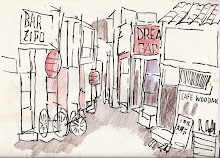
READY FOR A MOTOMACHI WEEKEND IN YOKOHAMA

READY FOR A MOTOMACHI WEEKEND... by roberthuffstutter
__________________________________
TAKING A TRIP BACK TO THE 60S WHEN JAPAN WAS REBUILDING, WHEN JAPAN WAS BECOMING THE SUPER ECONOMY OF THE WORLD. I WAS THERE AND WATCHED WITH GREAT ADMIRATION AND FASCINATION.
This is a sketch of one of my favorite weekend getaways in Yokohama where I could blend with the city and paint from my window, listening to the sights and sound of this most unique nation.
Thursday, August 4, 2011
INSPIRED BY VAN GOGH

VIEW FROM MY APARTMENT IN JAPAN IN 1963. Inpspired by Van Gogh's style. I only wish that he had been able to have visited Japan. I can only imagine what he would have painted. He often mentioned Japanese art; he admired Japanese art and lifestyle. What artist doesn't?
Sunday, July 31, 2011
S.S President Cleveland At Dock, Yokohama

S.S President Cleveland At... by glen.h
How I would have enjoyed this in the 1930s. My imagination soars. I could write a novel about this type of adventure.
Saturday, July 30, 2011
Imperial Palace and Lake at Hakone

Imperial Palace and Lake at... by ookami_dou
__________________________________
A picture is worth many words. Thanks to Wolfgang Wiggers
GEISHA GIRLS GONE BAD ? -- Two Japanese Women Hiding Their Faces in the Docket of a Tokyo Courtroom.

GEISHA GIRLS GONE BAD ? -- Two Japanese Women Hiding Their Faces in the Docket of a Tokyo Courtroom., a photo by Okinawa Soba on Flickr.
GEISHA GIRLS GONE BAD ? --... by Okinawa Soba
_________________________________
Thanks to OKINAWA SOBA for his research on Japanese basketheads. There is something for everyone in his photostream, especially those who have an interest in both old and new Japan and Okinawa.
Spring is Here

Spring is Here by Sue Ann Simon
________________________________
Truly, a masterpiece, a work of art. Only Japan can offer this breathtaking beauty. To return is my dream. Great photograph.
__________________________________
Photograph by Sue Ann Simon
SUNSET IN OLD JAPAN -- Heavily Photo Shopped over 100 Years Ago

SUNSET IN OLD JAPAN --... by Okinawa Soba
___________________________________
SUNSET IN OLD JAPAN -- Heavily Photo Shopped over 100 Years Ago
Ca.1880s-90s photograph by an unknown Japanese photographer. How was this image PhotoShopped over 100 years ago??? Very simple. The albumen photo (cooked into the silver-laced, egg-white emulsion by contact printing it directly under the sun) was then washed and fixed in the darkroom, and (here's the critical part) was taken into the back of the PHOTO SHOP where somebody with a palette of transparent water colors got out his brushes and COLORED IT. That's it. I didn't touch.
THE MAN WHO LOVED GEISHA GIRLS -- A Foreign Photographer in Old Meiji-era Japan

THE MAN WHO LOVED GEISHA GIRLS -- A Foreign Photographer in Old Meiji-era Japan, a photo by Okinawa Soba on Flickr.
THE MAN WHO LOVED GEISHA... by Okinawa Soba
___________________________________
THANKS TO OWINAWA SOBA whose Flickr Photostream is one of the most comprehensive photographic histories of Japan accessible to those interested in Japan.
The below text is from Okinawa Soba's photostream:
THE MAN WHO LOVED GEISHA GIRLS -- A Foreign Photographer in Old Meiji-era Japan
Herbert Ponting, seated second from the right (with thinning hair) was one of the great foreign photographers to capture the nation of Japan during the last years of the Meiji era. He visited many times during the years 1901 to 1906, and produced well over 1000 negatives from which several American stereoview publishers produced their BOXED SET TOURS of Old Japan. By 1908, his views of Japan dominated all others, and as far as foreigners go, he could rightly be called the 3-D KING OF JAPAN. (Among Japanese photographers, it was only T. ENAMI who held the same rank).
Ponting went on to publish the beautiful 1910 book IN LOTUS-LAND JAPAN, fully illustrated with half-stereoview plates, including several in color. Ponting's favorite Japanese photographer was T. ENAMI, and, like GEORGE ROSE of Australia, considered Enami's photographs as the only ones worthy enough to be included with his own offerings back home. He was also friends with the pioneering Japanese photographer and collotypist, K. OGAWA. While Ponting was resident in Japan, OGAWA published two books of Ponting's photographs -- most or all of the images being taken from stereoviews.
It was only later, after these years of photographic experience gained in Japan and around the world, that he went on to even greater fame as the expedition photographer on Robert Scott's ill-fated trip to the South Pole.
However, Ponting's personal life was far from a "Lotus-Land" of peace and harmony. This British citizen and one-time resident of America deserted his wife and young children in favor of traveling the world, feeling that domestic life hindered his expression as an "Artist". He was also a "loner" type, and did not seem to have any deep friendships or long-lasting camaraderie with other men.
However, there was one thing that he loved, and that was the GEISHA of Japan. He fawned after them, and sought their company whenever opportunity allowed. His compositions using Maiko and Geisha are many, and he photographed them with a passionate love for their presence "on the set".
For more about Herbert Ponting, search his name on the web. However, the best composite picture of his life is given in Terry Bennett's PHOTOGRAPHY IN JAPAN 1853-1912 (Tuttle, 2006) which is available from the author himself at www.old-japan.co.uk/books.html or from amazon.com.
A Flickr caption about Ponting's work with H.C. White is here : www.flickr.com/photos/24443965@N08/5059368232/in/photostr...
For more on Ponting's Japanese 3-D counterpart, see www.t-enami.org/
http://www.flickr.com/photos/24443965@N08/2360328226/in/photostream/
Friday, July 29, 2011
Abandoned

AN AMAZING PHOTOGRAPH OF AN ABANDONED TROLLEY OR TRAM. Thanks to Amy Kemp for sharing this in her Flickr Photostream.
__________________________________
This is worth its weight in yen. Your capture of all of the intricate details are most rare and unique for a find of such a transportation icon. This is most likely from the 1920s and ran through the war years.
Wednesday, July 13, 2011
JAPAN AIR LINES -- Here's Your Cigarettes. Smoke as Much as You Want. There's Plenty More Where They Came From !

JAPAN AIR LINES -- Here's Your Cigarettes. Smoke as Much as You Want. There's Plenty More Where They Came From !, a photo by Okinawa Soba on Flickr.
Wow, what a treasue. Only you, my friend, could come up with such excellent photographs. Thank you so much for making it possible to remember flying to Japan in the OK TO SMOKE ERA.....
My flight, A Pan American 707, departed San Francisco in August of 1961. Within ten minutes I was smoking my pipe.
We stopped in Hawaii for a half an hour to refuel. Shortly after leaving Hawaii, the stewardess were beautifully clad in kimonos and were passing complimentary Suntory drinks and Ashai or Sapporo beer.
It was the first of many, many Suntorys and Sapporos. It was the flight of my life, one I would not have wanted to miss. Whenever I get bored, all I have to do is recall that flight to the adventure of a lifetime.
Thank you for your ability to share. Thank for making your photos available to those who have such fond and special memories of Japan. It is good that you have posted these rare airline photos.
Your Flickr Photostream on and about Japan is a collection that defines the essence of Japan. Your collection ranks among the very best available on the subject of Japan through period photographs. Your writing and historical information is not only educational, it is most entertaining. Thank you, Robert.
Tuesday, July 12, 2011
TRIBUTE TO TERESA TENG

Tags for this photo:
Teresa-teng sankien-park music photos-of-japan yokohama-japan sankien-gardens petri 1961-japan 1962-japan 1963-japan music oriental-music music far-east tour-of-duty-usn blogaboutjapan blog-about-japan read-my-blogs japanese-architecture japanese-gardens roofs-of-japan traditional-japan creative-commons
Thursday, July 7, 2011
MY LAST DUTY STATION USS TORTUGA (LSD-26)

MY LAST DUTY STATION USS TORTUGA (LSD-26)
en.wikipedia.org/wiki/USS_Tortuga_(LSD-26)
When I reported for duty to the USS TORTUGA in February of 1964, the ship was in dry dock at Hunter's Point in San Francisco. For the first few months, we lived on shabby barges until the ship had been completely overhauled and refurbished. Once we got underway, the morale raised considerably.
MY LAST DUTY STATION USS TORTUGA (LSD-26)
It was not the kind of duty I was accustomed to after serving 28 months in the luxuries we were afforded in a post-war Japan.
My transfer from the Naval Air branch of the USN was not at my request but decisions were made that my service was needed aboard this vessel bound for some real adventure in the Orient.
The Tortuga was in drydock at Hunter's Point ( a real hell-hole) in San Francisco when I reported for duty in February of 1964. We were bunked in an old supply building on the docks until, alas, the flat-bottomed LSD was ready to get underway for numerous OPERATIONS AND READINESS cruises up and down the west coast from San Francisco to San Diego and back again. Up and down, down and up, close to shore, far from shore, docking and loading ammo, training at GQ throughout the day and night for nearly six months.
The Channel Islands, off the California coast, were used for strategic purposes during our training. Gunnery practice was conducted for hours on end during these readiness cruises.
If anyone figured out why we were undergoing such extensive training, nobody mentioned the subject. Such operations were normal after a vessel underwent a complelte overhaul.
We were not privy to what the purpose of such cruises and training were all about. Recalling these training cruises with very little time for going ashore, I have bittersweet emotions and memories of my final duty station aboard one of the oldest ships of its kind still in operation, but refurbished and ready for some real adventure in the far east.
My station during GQ was on the bridge, with a good view of what was happening.
MY FAVORITE BAR IN YOKOHAMA WITH BEN HUR SHADES

MY FAVORITE BAR IN YOKOHAMA WITH BEN HUR SHADES
The Ben Hur shades were all the rage in Japan in the early 60s. I had to spend what was the equivalent of $30 U.S. dollars to get my shades. For that amount, I could have spent three nights at Frank Lloyd Wright's famous hotel, THE IMPERIAL PALACE. ( I did spend a few nights there in 1961).
The Peanuts Club or Music Saloon was another story. It will always remain a fond memory. More about the Peanuts Club in other posts. Tags: Peanuts-Club Yokohama Japanese-Bars, etc.
I still have my shades and plan to take them with me when I return to Yokohama. I want to sit in a bar with these goofy glasses and buy all of the young women drinks. And I might do a few portraits too. Dream on, fool............

SANTA MONICA 28 March 1964

ONE OF THE BEST SETS OF THE OLD CALIFORNIA BEACH SCENE I have seen anywhere. A set of 23 beach photos taken by Lance Nix in 1964. When I want to go back in time, I go back to this set, time and again. Here's the link:
http://www.flickr.com/photos/81918828@N00/sets/72157615416275548/with/3361759980/
SANTA MONICA 28 March 1964 by Lance & Cromwell
Wednesday, July 6, 2011
Tamagawa Park Tokyo Dec 1957

THIS IS ONE VERY PRECIOUS PHOTOGRAPH. I can almost feel the joy that was in this youngsters heart and mind when he was scaring the photographer. Who is this little tiger? None other than Koji Kanemoto, my Flickr friend 54 years ago in Tokyo. Who would have guessed that our paths would have crossed at some later time in life?
Ueno Zoo July 25 1957

This is photo that touches the heart. I find it a darling photo of children. Taken in 1957 at the Ueno Zoo in Tokyo. Thanks to my friend Mustand Koji. Check out his Flickr Photostream.
___________________________________
When I was in Japan during the early 60s, children in these cute hats were everywhere, smiling, laughing and in love with the sights they were seeing. They were children on school outings and admired by all.
Tamagawa Park, Tokyo

Tamagawa Park, Tokyo
多摩川公園東京昭和31年 Tamagawa Park Tokyo 1957
The toddler is my Flickr friend, Mustang Koji, Koji Kanemoto. Take a few minutes and enjoy his vintage photo. Mustang is a car enthusiast and has some great shots of custom shows, people, places and family. He has shared some of his photos on his Flickr photostream that are heartwarming, historical and photos that will cause one to stop and think about our wonderful relationship with Japan during the past 65 years.
Saturday, July 2, 2011
Tokyo 1662

Photograph by Tokyoform. This is a prize-winning photograph of Japan. It is most likely in Tokyo, but it could be wherever there are small sake bars and entertainment cabarets. I could not believe the drama of such a scene when I first arrived in 1961, and I would most likely be equally shocked if I ever return. My goal is to return to Japan and spend time painting and photographing some unique scenes.
Thanks to TOKYOFORM...check out the photostream.
Akihabara

TIM SLESSOR PHOTOGRAPH of the Akihabara area of Tokyo. Tim travels the world. He is in the film industry and is one master photographer. I admire his work. He captures the essence of wherever he might be at the moment...
Sunday, June 26, 2011
Tokyo Tower

Paris has its tower, Seattle its tower, Shanghai has towers galore, but Tokyo's tower cannot be mistaken. It was built shortly after I departed.
Tim has captured a great photo.
Shopping in Shinjuku

One of my favorite photographs of Japanese enterprise and freedom. My congratulations to Tim Slessor.
Monday, June 20, 2011
Confirming schedule

the difference between YOKOHAMA WOMEN AND TOKYO WOMEN? Yokohama woman are not always in a hurry...Great photo by KASA51
Friday, June 10, 2011
YOKOHAMA'S YAMASHITA PARK, Painted on site 1962

A SHORT AND PERSONAL HISTORY OF MY LIFE ABOARD A TRAMP STEAMER By Robert L. Huffstutter
Back in the mid 1950s when I was a restless teenager and bored as hell with Kansas City, I wanted to get out of town and start living. I soon learned, passing Lawrence, Kansas, that I was going to have get a hell of a lot farther than Lawrence, Kansas to start seeing the world. And I had heard about tramp steamers. My English teacher back then, Mr. Smith, had mentioned the romance of the world of tramp steamers, so when I got home from my little trip to Lawrence without meeting any college cheerleaders, I started reading about tramp steamers and where I could find one that would sign me on so I could get to Hong Kong or Yokohama to start having some fun. Work? Sure, yes, I could work, I was young, and though not a giant, I could lift boxes and toss them up and aft and wherever, the kind of work I assumed would make up the life of a seaman.
Where does one go to find a tramp steamer I asked myself as I researched the library's reference section. No, I couldn't get to some English seaport to catch a steamer, besides they probably had all the help they needed. Was I longshoreman? I was barely a teenager, but maybe I could become a cabinboy. Afterall, didn't all the Naval heros start out as cabinboys, at least before we became free from the English? Going out of the country wouldn't work. I would have to find a port city in the USA to sign on. My aunt told me I should reconsider, finish school, get a real job. I wouldn't want to end up as a truckdriver would I? She said I would need a good education if I wanted to make more than $5 or $6 dollars an hour. I ought to try to get on at the steel mill where they were paying $7 an hour. That didn't appeal to me because I knew some friends whose dads worked there and they said it was hotter than hell inside those huge buildings. How about the BOP Plant at Leeds, not faraway. They built Buicks, Olds and Pontiacs. Well, I knew you had to be 18 and I didn't want to wait, I wanted to get on a ship where I could see the world, a tramp steamer. The idea appealed to me. I had just read Orwell's Down and Out In London and Paris and I figured Paris would be a great place to be down and out in, if only I could get there. Yes, I could start painting, meet a French woman, hang out in bistros and cabarets and have fun. And sooner or later, I would become famous, like that guy with the big nose that went to Tahiti and painted island women barely clad. Yes.
R.L.HUFFSTUTTER
Thursday, June 9, 2011
Japanese woman with mirrors

Japanese woman with mirrors
Accession Number: 1974:0034:0007
Maker: Shin-E-Do
Title: Japanese woman with mirrors
Date: ca. 1890
Medium: albumen print with applied color
Dimensions: 26.6 x 20.0 cm.
George Eastman House Collection
General – information about the George Eastman House Photography Collection is available at http://www.eastmanhouse.org/inc/collections/photography.php.
For information on obtaining reproductions go to: www.eastmanhouse.org/flickr/index.php?pid=197400340007.
Tuesday, June 7, 2011
yokohama

yokohama
1羽だけ逆向き。
This is one of the best photographs of the old HIKAWA MARU that I have ever seen. The gulls on the lines are a bonus. You are one excellent photographer. My congratulations to you for your capture of a ship I saw for the first time in 1961. Yokohama was and remains one of my favorite cities.
This is a memory that is fond and one that is bittersweet. It was near this ship, in Yamashita Park, where my love and I walked hand in hand time and again in the 60s.
Monday, June 6, 2011
Thursday, May 26, 2011
Decorative Hexagonal Origami Gift Boxs with Lids

am selling some origami gift boxes by auction to help survivors of the earthquake and tsunami in Japan.
This message is being sent to all those people who have indicated a possible interest in the subject, through their comments or "favourites" to photographs in my flickr photostream which have documented various fundraising efforts in Brighton in support of victims of the disaster.
Publicity is everything. If you would like to help market the auction, a "cut and paste" message - which explains everything - has been appended to this email.
Thank you.
Best Regards, Dominic
---------------------------------------
Subject: Origami Gift Box Auction to Help Japan Tsunami and Earthquake Survivors
From flickr.com/photos/dominicspics to lots of people...
Some Decorative Hexagonal Origami Gift Boxes are for sale by auction.
All proceeds - after some eBay and PayPal fees have been deducted - will be donated to the Japanese Red Cross Society.
The boxes - and links to each of their auctions - can be seen in better detail here:
www.flickr.com/photos/dominicspics/sets/72157626562622163/
Or go directly to the auctions here:
shop.ebay.co.uk/dominic_alves/m.html?_trksid=p4340.l2562
The auctions close from midnight after 2nd June 2011 British Summer Time (UTC + 1)
Postage to most parts of the world is free.
Please consider promoting these auctions to your contacts and via groups that you know may be interested in participating in, or publicising, the auctions - including via facebook or twitter.
We are all cousins.
Thursday, May 19, 2011
Krap Kawasaki

Krap Kawasaki by PoPBunka! 英会話 浜松市
___________________________________
Shortly after arriving in Japan, I bought a motorcycle for $25 U.S. Dollars from a Navy buddy. I kept it a few months until I had to start getting off of the bike in order to get it to go up hills. The day the school bus of children went by and looked out the window at me like I was crazy was the limit. I got rid of the bike the next day--I sold it for $25 to somebody who said they knew how to fix the bike. The next time I saw them, they were pushing the bike up a hill, not at all happy. It was a "Krap Cycle" for sure.
Tuesday, May 17, 2011


Monday, May 16, 2011
ChinaShopAshiaJapan1953

When my friends found out I had a set of orders to Japan, they were quite envious of my new duty station and many asked me if I could send them home a set of Noritake China. I found myself way too busy having fun to go shopping for certain or specific floral patterns of China.
__________________________________
Another excellent photo by Wilbert Bregar, taken during his tour in Japan while in the USAF. Thanks to Wilbert for the permission to exhibit his copyrighted photos in my BLOGABOUTJAPAN.
FredsPixAT6JapanAF53

FRED WAS STATIONED IN JAPAN IN THE EARLY 1950S and has more than 50 photos of his tour in Japan while he was in the USAF. To see his photos on FLICKR, follow the link below:
http://www.flickr.com/photos/wl-bregar/3302404352/in/set-72157614009862487
THANKS TO FRED BREGAR FOR HIS SERVICE...
Sunday, May 15, 2011
Two Bars' Doors

Why do I like this photo is the question after telling you about my experiences, etc. Sorry to be so self-absorbed and fail to comment on the qualities of your work.
The above photo has terrfic contrast, mystery, intrique and textures in materials. It is a photo that I would reckognize being in no other country but Japan.
There is just something about the Japanase spatial talents and ability to compress that makes for interesting subject matter.
Saturday, May 14, 2011
sunset (Explored 12 May 11)

Hello, Chief..........this is one of the best. Don't believe I have ever seen both Enoshima and Mt Fuji in same frame or image. This is very rare--and very beautiful.
This is the kind of photo some will wait years to get just right. You got it. Time, air, everything about it is perfect. I especially like the way the lights twinkle in the sea air. I am presuming this is sunset or twilight time?
___________________________________
Photo by Brad, Photostream: i_love_japan_27
KIRIN BEER EMPTIES IN ALLEY

a photo by roberthuffstutter on Flickr.
Imagine my surprise when I saw Bun Oshita's photo of a case of empty Kirin bottles outside of a Yakitori restaurant in Yokohama. Immediately, I was reminded of the photo I took of a case of empty Kirin beer bottles 50 years ago in the same area of Yokohama. I had just purchased a new Petri 35 MM camera and began shooting photos in B/W and color slides. The year was 1961. I am thrilled to have found Mr. Oshita's Flickr Photostream. It is full of many great photos.
Yakitori restaurant

Photograph of a Yakitori Restaurant by Bun Oshita, a Yokohama gentleman whose photos I admire very much. There are many great photos of Yokohama in his Flickr Photostream. It is a personal joy to see such great photography of the Yokohama I loved so very much 50 years ago.
Alley in old Yokohama

AN ALLEY IN OLD YOKOHAMA...Isezakicho Street
Photograph by Bun Oshita
___________________________________
I recall this street when it was decorated with beautiful paper lanterns and real cherry blossoms during Sakura Season. It was a time of great celebration; sake and Sapporo beer, Asahi beer, Suntory whisky and sushi were free to all who chose to wander down this street of wonders,old Isezakicho Street. Hopefully, I will be able to walk down this most famous street again before I leave this earth.
Thursday, May 12, 2011
Chitose6404

LOOKING THROUGH YOUR PHOTOSTREAM...makes me so sad that I did not visit Hokkaido while I was in Japan. But I shall, if it is possible, visit this beautiful island of Japan when I visit Japan once more sometime in the next year or so. Yes, it appeared so rural and natural from the 60s photos. I know I would have fallen in love with Hokkaido as I did the main island. You have a most fantastic collection of photos. Robert
Thank you for your permission to place a few of them in my BLOGABOUTJAPAN
Streetcar in Tokyo near Shinbashi Station, circa 1955

Streetcar in Tokyo near Shinbashi Station, circa 1955
Mid 1950s Tokyo. A horde of pedestrians crosses in front of a 6000-series Tokyo metropolitan streetcar.
The sign in the foreground says that this is A Avenue and 10th Street. The US military imposed a system of street names on the major thoroughfares in Tokyo after the end of World War Two. Lettered avenues radiated from the Imperial Palace clockwise. "A Avenue" ran south from the southeast corner of the Imperial palace, on Hibiya Boulevard (Hibiya Doori). The numbered streets were basically major roads essentially ringing the palace. 10th is Outer Moat Boulevard (Sotobori Doori). So this is the Nishi-shinbashi Crossing, just south of Hibiya Park. At the time the neighborhood - and the streetcar stop - was called Tamuramachi (田村町). We must be looking east, because the sun is hitting the face of the building on the right.
It pre-dates 1957, when Tokyo's streetcars were repainted yellow. The lines which ran on Hibiya Doori through this intersection were 1, 5, 35 and 37.
Here's a zoom on a part of the map published by the US military in 1948 with the street names.
And here's the neighborhood on an interactive 1956 map of Tokyo.
Found in an antique store's photo bins.
______________________________________________________________________
COMMENTS FROM ROBERT L. HUFFSTUTTER
One of the joys of having been stationed in Japan for over two years was that the dollar was worth 360 yen at that time, but it was the people, always polite, nice and helpful. Not once in 28 months did I ever have a bad experience and I wandered off into the depths of Tokyo in the middle of the night. The streetcars were almost like an amusement park ride, especially late at night around the Bund in Yokohama. They would get up some real speed, sparks would fly and the entire care would shake, rattle and roll. Yes, for ten yen I could ride all over. I just got on the streetcars and let them take me wherever. For a young guy 19, Japan was like one big holiday without end. Unfortunately, my tour ended. See my BLOGABOUTJAPAN for more about streetcars
Thanks to Rob Ketcherside for posting this found photo--it brings back some warm memories, though bittersweet at times because of the SAYONARA FACTOR....
Izakaya at road side

IZAKAYA AT ROADSIDE BY NOBUOJP
This a perfect example of the Japanese sake bars I saw while spending a tour of joyful duty in Japan in the early 1960s. While these were for the local Japanese, whenver an American wondered in, he was treated with respect and offered sake. In Yamato, I had a favorite sake bar I frequented.
On more than one occasion, my Japanese friends made sure I made it home to my small apartment in Yamato. 50 years have passed, but I still have warm memories of my time in Japan whenever I see photos like these with many lanterns. Thank you for sharing this special photograph. Robert
Wednesday, May 11, 2011
Vintage Japanese matchbox label, c1920s-1930s

THIS IS ANOTHER CLASSIC IMAGE OF A JAPANESE MATCHBOX popular in the 1920s through the 1960s.
Crackdog's collection of matchboxes is awe-inspiring. While many are for bars and other establishments, subjects that make the issue a memory of some youthful joys, it is the designs that remain in my mind that I really appreciate.
Most of these matchboxes, or all of them, were created by Japanese advertising artists in the 1920s through the late 1930s and could be advertising any number of establishments that were part of a very large Japanese Empire.
It is the intrique and mystery of this historic era that fascinates me. I believe it is an era that has been shelved, more or less, because of the Imperialist nature.
As an American, let me be the first to admit that the United States was one of the main players in the game of colonialism and imperialism. From the time the U.S. declared the "Manifest Destiny" to the time we forcefully annexed the kingdom of Hawaii, we have subtly become very large realtors in world properties.
Tuesday, May 10, 2011
MT. FUJI IN THE BACKGROUND OF THIS VIEW OF EDO

MT. FUJI IN THE BACKGROUND OF THIS VIEW OF EDO
UNLESS THE VIEWER IS INTERESTED IN HISTORICAL EVENTS, DOCUMENTS AND ART, these images might not stir one's excitement in the past. These engravings were not imagined, but were made from sketches by an artist who furnished them for the voyage.
Since there was no photography at this point in time that could capture old Tokyo as it was in the 1840s, we must assume that Tokyo, or Edo, or Yeddo, looked very similar to the above.
I would guess that the view might include what might be part of the Emperor's Palace.
Subscribe to:
Posts (Atom)

 Posts
Posts