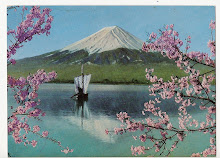
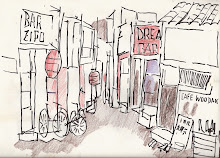
Exactly what was on my mind when I painted this picture was the joy and thrill of being in a country I had long dreamed of seeing, a country as different from America as day was from night. From the moment I arrived in Japan in August of 1961, it was love at first sight. I liked the sounds, the variety of smells and scents, the totally different buildings, the people.
Being an artist, I wanted to capture the scenes. I started sketching on street corners and found that the people would gather about. I liked the attention, especially the attention of the young ladies--such beautiful young women with their long and beautiful hair worn casually with soft curls at shoulder length.
Painted from hotel window in Yokohama in 1961. Tempra, pen and ink, with sake. Plein-aire with smoke.
Painted this scene, and many others, from hotel window in Yokohama shortly after arriving in Japan in 1961. Somewhere among my old memorabilia there are a few more of these plein-aire paintings. Many, however, were given to the bar and shop owners in the areas where I stayed, mostly in Motomachi and sometimes, Chinatown and the Bund area.
YOKOHAMA PICTURE SHOW

Shot with my Petri in Yokohama 1962
RICE FIELD IN JAPAN 1962
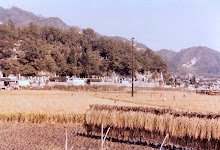
I took this with my PETRI in Kanagawa Prefecture
Thursday, December 1, 2011
MOTOMACHI STREET SCENE 1962, By Robert L.Huffstutter

Friday, November 25, 2011
Streetcar in Tokyo near Shinbashi Station, circa 1955

Mid 1950s Tokyo. A horde of pedestrians crosses in front of a 6000-series Tokyo metropolitan streetcar.
The sign in the foreground says that this is A Avenue and 10th Street. The US military imposed a system of street names on the major thoroughfares in Tokyo after the end of World War Two. Lettered avenues radiated from the Imperial Palace clockwise. "A Avenue" ran south from the southeast corner of the Imperial palace, on Hibiya Boulevard (Hibiya Doori). The numbered streets were basically major roads essentially ringing the palace. 10th is Outer Moat Boulevard (Sotobori Doori). So this is the Nishi-shinbashi Crossing, just south of Hibiya Park. At the time the neighborhood - and the streetcar stop - was called Tamuramachi (田村町). We must be looking east, because the sun is hitting the face of the building on the right.
It pre-dates 1957, when Tokyo's streetcars were repainted yellow. The lines which ran on Hibiya Doori through this intersection were 1, 5, 35 and 37.
There's an outside chance that this streetcar is 6103 (see the trailing digit 3), which is now in Shinmei Toden Shako Park in Bunkyo Ward.
Here's a zoom on a part of the map published by the US military in 1948 with the street names.
And here's the neighborhood on an interactive 1956 map of Tokyo.
Found in an antique store's photo bins.
Text by Rob Ketcherside
_________________________________
This is a fond reminder of the era. I was here in the early 60s.
Monday, November 21, 2011
TRAINS OF YOKOHAMA IN EARLY 60S

Scanned from a slide shot with my Petri 7. I have a lot of slides I need to scan before too much more time passes. I don't know how many years a slide will last, but this one was shot in 1961, so it's 50 years old and doesn't look too bad after a little editing with PICNIK.
There was still much reconstruction going on doing my tour of duty.
Now, after the terrible tragedy of the recent earthquake and tsunami, there will be more years of construction and sorrow
Friday, November 18, 2011
View of Fuji-san from Kamakura, Japan

THIS IS A MASTERPIECE. Since leaving Japan in 1963 after nearly three years, I have longed to return someday to see Mt. Fuji. If I cannot make it, this photograph is almost like seeing Fuji-San in person.
You have captured this scene in a manner that makes it appear as it might have been seen a century ago.
Your lighting, framing and attention to details has made this scene one of the best I have seen during the past 50 years. Thanks for sharing this memory.
__________________________________
My gratitude to Mikael Tilly for such a great photograph.
THE PEANUTS CLUB---PART OF MATCHBOX COLLECTION

Part of my matchbox collection of Japanese bars I frequented. The PEANUTS CLUB has some very special memories for me. It was there where I would meet a young Japanese girl I would remember for the rest of my life.
THE PEANUTS CLUB IN YOKOHAMA: 1961, 1962, 1963...four floors with an elevator of live music..(日本語ロック論争,

THE PEANUTS CLUB IN YOKOHAMA: 1961, 1962, 1963...four floors with an elevator of live music..(日本語ロック論争,, a photo by roberthuffstutter on Flickr.
THE PEANUTS CLUB IN YOKOHAMA: 1961, 1962, 1963...four floors with an elevator of live music..(日本語ロック論争,
Unless one really knew about the Peanuts Club, or heard the music playing all night and all day, one might walk by the somewhat austere fascade where the arrow pointed up. But really, one had only to be in the service or in their teens to know about the Peanut or Peanuts Club. It attracted the likes of my type, a young guy in the service, Japanese teenagers in their late teens and dependents in their late teens who lived at the Yokohama Housing for U.S.Service and Government employees. It was the coolest musical pub and coffee bar or pub in Yokohama.
WHO REMEMBERS THE WIEN COFFEE SHOP?

I told her I did not know where the Wein Coffee Shop was located. She wrote the address or directions on a piece of paper and told me to give it to taxi man. "He knows, I know," she said. "We meet at noon, okay?" I squeezed her hand and smiled. She returned my smile.
pond at sankeien

THIS PHOTOGRAPH BY MOLLY DES JARDIN is a marvelous capture of a special memory. Her photo seems to have captured the park exactly as I recall seeing it for my first time, in the autum of 1962.
Sankien Gardens is the first place my new friend and I went.
We had both discussed how we liked to sketch, thus we decided to meet at a nearby coffee and wine shop and proceed from there.
I told her I did not know where the Wein Coffee Shop was located. She wrote the address or directions on a piece of paper and told me to give it to taxi man. "He knows, I know," she said. "We meet at noon, okay?" I squeezed her hand and smiled. She returned my smile.
Did I believe she would really be there at noon? I hoped she would be. I was already in love with this young lady who still had on her blue Middy blouse. I escorted her down the stairs to a waiting taxi. We did not kiss good night. I waved as the taxi pulled out into the Yokohama traffic of the wee hours of the morning.
Wow, I thought, I might have finally found the young woman of my dreams. I returned up the stairs of the Peanut Club as a western band and singer were doing a Patsy Cline version of "I Fall to Pieces."
Sunday, November 6, 2011
Kyoto Gion

THIS IS A PHOTO THAT REMINDS ME OF THE EARLY 60S. THANKS TO jpellgen FOR SHARING THIS PHOTOGRAPH.
___________________________________
Gion, Kyoto... A very traditional area just beyond the Kamo-gawa which is undoubtedly the most famous place in Japan to see Geiko activity. The area surrounding Gion is home to Yasaka Shrine, as well as Hanami-koji, a street lined with old ochaya (tea houses) and restaurants.
__________________________________
Take a tour of JPELLGEN'S photos by following the highlighted text.
Japan : Beautiful Samurai

Japan : Beautiful Samurai
芸妓 君香さん
The geiko (geisha) Kimika plays the 12th century samurai warrior Tomoe Gozen in the Jidai Matsuri, one of the three big festivals of Kyoto, Japan.
Over 2,000 people, including many geiko (geisha) and maiko (apprentice geisha), wore costumes representing various eras of Kyoto's 1,200-year history as they paraded through the city.
Kyoto was the capital of Japan from 794 until 1868. It is now the seventh largest city in Japan.
_________________________________
Thanks to Michael Chandler for a beautiful photograph. You are able to go to his Flickr Photostream by following the highlighted text and/or title.
Thursday, November 3, 2011
YAMATO TRAIN STATION 1963 JAPAN 日本

YAMATO TRAIN STATION 1963 JAPAN 日本
.This was done at the Yamato Train Station in Yamato, Japan in 1962. While stationed in a Naval Air Squadron based at NAS Atsugi, Japan from 1961 through the eve of 1964, I sketched many scenes of local towns, bars and city scenes. Many were given to bar owners and friends.
When I purchased a new Petri, my first 35mm camera, I enjoyed shooting photos. Looking back almost 50 years, I must admit that my tour in Japan was one of the most exciting times of my youth.
THE BEGINNING OF A SUPER ECONOMY IN JAPAN

From the ruins of a devastated nation to one of the world's super economic powers. There are many nations that might well learn much about Japan. It is not Japan's natural resources that has made it a success, it is Japan's character.
Unless a nation has character, it will remain poor and hopeless. There are many factors here that some nations will never understand because they have decided to hate free enterprise and especially American democracy.
I have more admiration for Japan than any other nation on earth, except my own USA. Having lived in Japan for more than two years in the early 60s, I recall the energy that was exhibited by the people rebuilding a nation.
I frequently traveled from Atsugi to Yokohama and Tokyo by train and watched the progress. I saw piles of glass of different colors almost everywhere. I asked my close friend what it was and what it all meant. She told me that it was "saving glass for making new glass." Now, looking back, I realize it was recycling.
When walking around Yoiohama as I so frequently did, I saw workers building one project after another. There was always the sounds one hears around men involved in construction. On more than one occasion, I was offered to share a bit of lunch with workers who did not speak English but extended friendship in the strange fare of fish and rice in various forms. At the time, I thought it a nice thing to do; in retrospect, I realize it was much more than something simply nice or polite. Yes, I harbor many deep and wonderful emotions when I think of Japan.
By Robert L. Huffstutter
I now have a public group called BLOGABOUTJAPAN which appears in the Flick Photostream. It is open to those who would enjoy posting positive photos, art and information about Japan.
Monday, October 31, 2011
HIROSHIGE AND VAN GOGH: BRIDGE IMAGES

HIROSHIGE AND VAN GOGH...the first image in my blog about Japan.
BLOGABOUTJAPAN
Tuesday, October 25, 2011
yokohama

yokohama
1羽だけ逆向き。
This is one of the best photographs of the old HIKAWA MARU that I have ever seen. The gulls on the lines are a bonus. You are one excellent photographer. My congratulations to you for your capture of a ship I saw for the first time in 1961. Yokohama was and remains one of my favorite cities.
This is a memory that is fond and one that is bittersweet. It was near this ship, in Yamashita Park, where my love and I walked hand in hand time and again in the 60s.
__________________________________
yokohama by kosukeszk
Saturday, October 22, 2011
Original

Another favorite from the Flickr Photostream posted by Mustang Koji, one of my favorite photographers and curators of photos from Japan of another era. Many of the photos in Mustang Koji's photostream were taken by his father, an Army Sergeant in the U.S. Army during the Occupation era. This photo is one of Mustang Koji's aunts. She is a beautiful lady.
__________________________________
This is the original B&W of the magazine cover showing my Aunt Eiko. Over the years, it had gotten cut at odd angles.
Taken in 1948 in Occupied Japan.
SOMEDAY I WILL WRITE MY NOVEL ABOUT JAPAN

Matsuzakaya PX

The main street of Tokyo, it was a
"must see" for me.
I clearly remember my New Year's eve at an expensive and upscale club on the Ginza on New Year's eve of 1961/1962.
This was before I met the young lady of my dreams, so I spent the evening with one of my best Navy friends. Shortly after our big party on that New Year's eve, he was commissioned as a Lieutenant-Junior Grade and sent to Naval Aviator's flight school in Pensacola. Had my eye sight been 20/20, I would have enjoyed the same duty, but I would never have met the young lady that still makes my life sweet by simply remembering her.
Life is full of joys and contradictions, but I must accredit much to Fate.
The Ginza, with its many lights must surely be quite different today than it was on New year's Eve of 1961.
___________________________________
THANKS TO MY FRIEND KOJI KANEMOTO, for permission to post this photo. It was taken by his father, a Seargeant in the U.S.Army whose duties helped Japan reconstruct the nation throughout the Occupation.
___________________________________
Matsuzakaya PX by Mustang Koji
Monday, October 17, 2011
"The boat Vincent used while drifting down the Sumida with Mariko..."

"The boat Vincent used while drifting down the Sumida with Mariko...", a photo by roberthuffstutter on Flickr.
"The boat Vincent used while drifting down the Sumida with Mariko..."
Theo arranged a trip to Japan to help Vincent defeat the despondency he was suffering. Exactly how long he stayed is not known; in fact, it was only recently discovered that Van Gogh visited Japan.
___________________________________
This watercolor with pen and ink is one in a series I have done that features a fictional "secret trip" to Japan by Vincent Van Gogh. I only wish that Van Gogh had been able to have spent several years in Japan. One can only imagine the works he would have done.
Thursday, October 13, 2011
Streetcar in Tokyo near Shinbashi Station, circa 1955

This really reminds me of the Japan I knew in the early 1960s. I want to paint this one.
___________________________________
Streetcar in Tokyo near... by Rob Ketcherside
PHOTO BY ROB KETCHERSIDE
Tuesday, October 11, 2011
Hakone

The title of this work by Emilien Deloche is "Week end in Hakone"
________________________________
Hakone is probably one of the most romantic spots for spending a weekend with a loving friend. The last time I spent a weekend in Hakone was in 1963 and the memories are still warm and exciting to my mind; they are moments I recall now and then while in a wishful thinking kind of mood.
Tokyo_Shibuya/東京、渋谷

Tokyo_Shibuya/東京、渋谷
Early in the morning at the Starbuck
__________________________________
Emilien Deloche is the administrator of a public group featured on Flickr. It is for sketches of and about Japan, a great visual treat for all who are fascinated by Japan.
Friday, October 7, 2011
BRIEF STATS FOR JAPANESE ECONOMY BEGINNING 1955

CHARACTER, NOT RESOURCES, HAS MADE JAPAN AN ECONOMIC SUPER POWER
From the ruins of a devastated nation to one of the world's super economic powers. There are many nations that might well learn much about Japan. It is not Japan's natural resources that has made it a success, it is Japan's character.
Unless a nation has character, it will remain poor and hopeless. There are many factors here that some nations will never understand because they have decided to hate free enterprise and especially American democracy.
Robert L. Huffstutter
Wednesday, October 5, 2011

Saturday, October 1, 2011
Honda van

Howard's Flickr Photostream is full of unique and rare, or seldom-seen vehicles. This little Honda van surely served its purpose well. One can imagine how easily pizzas could be delivered in and around the narrow alleys of Tokyo and Yokohama. For more information about this van, here the web site:
http://lanemotormuseum.org/honda-life-step-van-1973
___________________________________
Thanks to Howard for this refreshing photo of another time in Japan's spectacular automotive history.
Friday, September 30, 2011
1963 Isuzu Bellett

1963 Isuzu Bellett
This is my aunt's first new car, a 1963 Isuzu Bellett. She had it only for one year, she tells me, as she wanted something sportier. She traded it in on a 1964 Isuzu Bellett GT of which no picture remains.
It is parked in the driveway (a rarity) of my grandparent's home in Tokyo, Setagaya Prefecture, Fukasawa 5-3. The house was only recently built in the mid-50s due to the war's aftermath.
東京都世田谷区深沢5-3
__________________________________
thanks to MUSTANG KOJI for use of photo
Wednesday, September 28, 2011
kurashiki alley

Marvelous photography.......as though one was transported back to the 15th century, or in my case, 1963, when I was last here in Japan. I always found similar scenes that time had not changed. Great find and great shot.
_________________________________
PHOTOGRAPH BY JACOB, Flickrphotostream called ENNUI MARCH
Monday, September 26, 2011
PRIZE WINNING PHOTOS OF JAPAN


PRIZE WINNING PHOTOS OF JAPAN, a group on Flickr.
http://www.flickr.com/groups/prize-winning_photos_of_japan/
__________________________________
PRIZE WINNING PHOTOS OF JAPAN

 Posts